Do you think you really know what your dog thinks of you? Can you imagine if there was a way to know what your little friend really has in his mind? Well, with the help of MRI scanners, scientists attempt to reveal exactly that!
In the 30,000 years humans and dogs have lived together, man's best friend has only become a more popular and beloved pet. Today, dogs are a fixture in almost 50% of American households.
From the way dogs thump their tails, invade our laps and steal our pillows, it certainly seems like they love us back. But since dogs can't tell us what's going on inside their furry heads, can we ever be sure?
Actually, yes. Thanks to recent developments in brain imaging technology, we're starting to get a better picture of the happenings inside the canine cranium.
That's right — scientists are actually studying the brains of dogs. And what the studies show is welcome news for all dog owners: Not only do dogs seem to love us back, they actually see us as their family. It turns out that dogs rely on humans more than they do their own kind for affection, protection and everything in between.
The most direct brain-based evidence that dogs are hopelessly devoted to humans comes from a recent neuroimaging study about odor processing in the dog brain. Animal cognition scientists at Emory University trained dogs to lie still in an MRI machine and used fMRI (functional magnetic resonance imaging) to measure their neural responses to the smell of people and dogs, both familiar and unknown. Because dogs navigate the world through their noses, the way they process smell offers a lot of potential insight into social behavior.
The scientists found that dog owners' aroma actually sparked activation in the "reward center" of their brains, called the caudate nucleus. Of all the wafting smells to take in, dogs actually prioritized the hint of humans over anything or anyone else.
These results jibe with other canine neuroimaging research. In Budapest, researchers at Eotvos Lorand University studied canine brain activity in response to different human and dog sounds, including voices, barks and the meaningful grunts and sighs both species emit. Before this study, we had no idea what happens inside canine brains when humans make noise.
Among other surprising findings, the study revealed marked similarities in the way dog and human brains process emotionally laden vocal sounds. Researchers found that happy sounds in particular light up the auditory cortex in both species. This commonality speaks to the uniquely strong communication system underlying the dog-human bond.
In short: Dogs don't just seem to pick up on our subtle mood changes — they are actually physically wired to pick up on them.
"It's very interesting to understand the tool kit that helps such successful vocal communication between two species," Attila Andics, a neuroscientist and lead author of the study, said. "We didn't need neuroimaging to see that communication works [between dogs and people], but without it, we didn't understand why it works. Now we're really starting to."
Behavior research supports the recent neuroscience too. According to Andics, dogs interact with their human caregivers in the same way babies do their parents. When dogs are scared or worried, they run to their owners, just as distressed toddlers make a beeline for their parents. This is in stark contrast to other domesticated animals: Petrified cats, as well as horses, will run away.
Dogs are also the only non-primate animal to look people in the eyes. This is something Andics, along with other researchers, discovered about a decade ago when he studied the domestication of wolves, which he thought would share that trait. They endeavored to raise wolves like dogs. This is a unique behavior between dogs and humans — dogs seek out eye contact from people, but not their biological dog parents.
"Bonding with owners is much more important for dogs than other pets," said Andics.

Scientists have also looked at the dog-human relationship from the other direction. As it turns out, people reciprocate dogs' strong feelings. In a study published in PLOS One in October, Massachusetts General Hospital researchers measured human brain activity in response to photos of dogs and children. Study participants were women who'd had dogs and babies for at least two years. Both types of photos sparked activity in brain regions associated with emotion, reward, affiliation, visual processing and social interaction. Basically, both furry and (typically) less-furry family members make us equally happy.
Dog-lovers have committed a few notable gaffes in interpreting dogs' facial expressions, e.g., assuming the often-documented hangdog look signifies guilt, an emotion that, most behavior experts agree, requires a multifaceted notion of self-awareness that dogs probably don't have.
But, as with family, our instinctive hunches about dog behavior are often correct.
"Sometimes our intuition about what's going on inside dogs' heads is dead-on," said Laurie Santos, the lead researcher at Yale's Canine Cognition Center. "Like, that dogs are seeking out help from us — and that's true based on studies — which is different from even their closest relatives, wolves."
The precise wish or worry lurking in a dog's doleful look may not always be clear. But we can relish the fact that we know our pets love us as much as we hoped, maybe even more. Even if they're not full-fledged children, they see us as family. And to us? Well, they'll always be our babies.
Editors' Recommendations:
15 Photos That Prove Dogs Can Fall Asleep Anywhere
Pup Who Can't Walk Rushes To Reunite With Her Airman Daddy--Awww!
Touching Time-Lapse Of Rescued Puppy Growing Into Adulthood
A Therapy Dog Helps A Boy With A Traumatic Brain Injury Recover
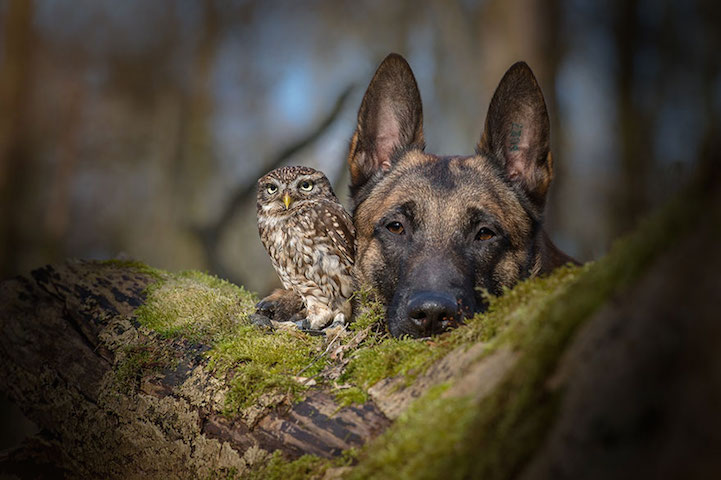
15 Photographs Of The Unlikely Sweet Friendship Of A Dog And An Owl
source: Mic

In the 30,000 years humans and dogs have lived together, man's best friend has only become a more popular and beloved pet. Today, dogs are a fixture in almost 50% of American households.
From the way dogs thump their tails, invade our laps and steal our pillows, it certainly seems like they love us back. But since dogs can't tell us what's going on inside their furry heads, can we ever be sure?
Actually, yes. Thanks to recent developments in brain imaging technology, we're starting to get a better picture of the happenings inside the canine cranium.
That's right — scientists are actually studying the brains of dogs. And what the studies show is welcome news for all dog owners: Not only do dogs seem to love us back, they actually see us as their family. It turns out that dogs rely on humans more than they do their own kind for affection, protection and everything in between.
 |
| Dogs gathered around MRI scanner MR Research Center in Budapest. Image Credit: Borbala Ferenczy |
The scientists found that dog owners' aroma actually sparked activation in the "reward center" of their brains, called the caudate nucleus. Of all the wafting smells to take in, dogs actually prioritized the hint of humans over anything or anyone else.
These results jibe with other canine neuroimaging research. In Budapest, researchers at Eotvos Lorand University studied canine brain activity in response to different human and dog sounds, including voices, barks and the meaningful grunts and sighs both species emit. Before this study, we had no idea what happens inside canine brains when humans make noise.
Among other surprising findings, the study revealed marked similarities in the way dog and human brains process emotionally laden vocal sounds. Researchers found that happy sounds in particular light up the auditory cortex in both species. This commonality speaks to the uniquely strong communication system underlying the dog-human bond.
In short: Dogs don't just seem to pick up on our subtle mood changes — they are actually physically wired to pick up on them.
"It's very interesting to understand the tool kit that helps such successful vocal communication between two species," Attila Andics, a neuroscientist and lead author of the study, said. "We didn't need neuroimaging to see that communication works [between dogs and people], but without it, we didn't understand why it works. Now we're really starting to."
 |
| Dog waiting to be scanned at MR Research Center in Budapest. Image Credit: Borbala Ferenczy. |
Behavior research supports the recent neuroscience too. According to Andics, dogs interact with their human caregivers in the same way babies do their parents. When dogs are scared or worried, they run to their owners, just as distressed toddlers make a beeline for their parents. This is in stark contrast to other domesticated animals: Petrified cats, as well as horses, will run away.
Dogs are also the only non-primate animal to look people in the eyes. This is something Andics, along with other researchers, discovered about a decade ago when he studied the domestication of wolves, which he thought would share that trait. They endeavored to raise wolves like dogs. This is a unique behavior between dogs and humans — dogs seek out eye contact from people, but not their biological dog parents.
"Bonding with owners is much more important for dogs than other pets," said Andics.

Dog-lovers have committed a few notable gaffes in interpreting dogs' facial expressions, e.g., assuming the often-documented hangdog look signifies guilt, an emotion that, most behavior experts agree, requires a multifaceted notion of self-awareness that dogs probably don't have.
But, as with family, our instinctive hunches about dog behavior are often correct.
"Sometimes our intuition about what's going on inside dogs' heads is dead-on," said Laurie Santos, the lead researcher at Yale's Canine Cognition Center. "Like, that dogs are seeking out help from us — and that's true based on studies — which is different from even their closest relatives, wolves."
The precise wish or worry lurking in a dog's doleful look may not always be clear. But we can relish the fact that we know our pets love us as much as we hoped, maybe even more. Even if they're not full-fledged children, they see us as family. And to us? Well, they'll always be our babies.
Editors' Recommendations:
15 Photos That Prove Dogs Can Fall Asleep Anywhere
Pup Who Can't Walk Rushes To Reunite With Her Airman Daddy--Awww!
Touching Time-Lapse Of Rescued Puppy Growing Into Adulthood
A Therapy Dog Helps A Boy With A Traumatic Brain Injury Recover
15 Photographs Of The Unlikely Sweet Friendship Of A Dog And An Owl
source: Mic




.jpg)


.jpg)